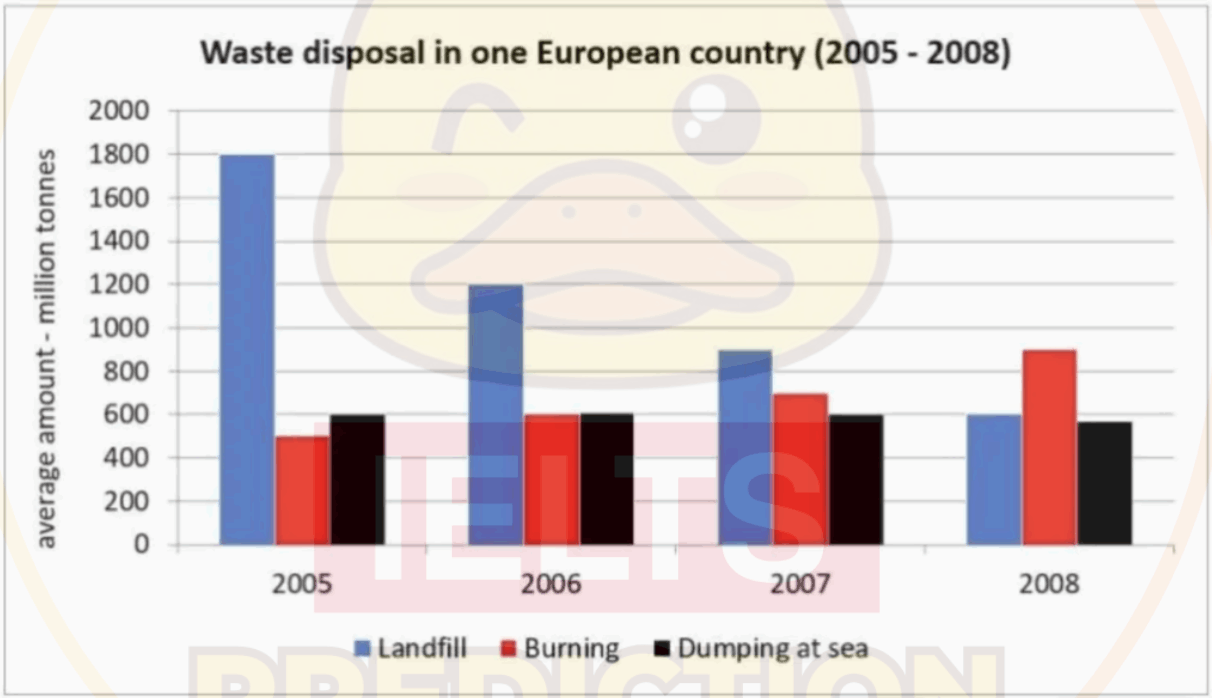
The chart below shows different methods of waste disposal in a European country from 2005 to 2008.
Practice this IELTS Writing Task 1 question on IELTSX. The chart below shows different methods of waste disposal in a European country from 2005 to 2008.
Waste Disposal Methods European Country 2005-2008 Bar Chart - IELTS Writing Task 1
You should spend about 20 minutes on this task.
Summarise the information by selecting and reporting the main features, and make comparisons where relevant.
Write at least 150 words.
A student's answer to this task, and the feedback on it
Written by an IELTSX user under exam conditions and published unedited and anonymously. Band 8 · 166 words.
The bar chart illustrates three different methods of waste disposal—landfill, incineration, and dumping at sea—in a European country between 2005 and 2008.
Overall, landfill was by far the most widely used method throughout the period, despite a steady decline that resulted in a lower share in the final year. By contrast, incineration showed the opposite pattern, increasing steadily from the lowest level to its peak. Meanwhile, the figures for dumping at sea remained largely unchanged over the period.
In 2005, landfill accounted for approximately 1,800 million tonnes of waste. However, this amount fell consistently over the years, bottoming out at around 600 million tonnes by 2008.
Incineration began at roughly 500 million tonnes in 2005 and experienced gradual growth throughout the period, reaching about 700 million tonnes in the final year.
As for dumping at sea, the amount of waste disposed of stood at around 600 million tonnes at the start of the period and remained stable from 2005 to 2007 before dipping merely in 2008.
Examiner feedback
This is a very strong Band 8.0 performance. The writing is clear, accurately reflects the data, and uses a high level of grammatical precision. To reach Band 9, the response could incorporate more comparative language (comparing the methods against each other at specific points in time) rather than describing them largely in isolation.
Task Achievement - 8
- The response covers all requirements of the task, including all three waste disposal methods across the entire time period. - A clear overview is provided, highlighting the main trends (decline in landfill, increase in incineration, stability in sea dumping). - Key features are clearly highlighted with accurate data, though more direct comparisons between the categories in the body paragraphs would have enhanced the response further.
Coherence & Cohesion - 8
- Information is logically organized; the response moves from an overview to specific details for each method. - Cohesive devices (e.g., 'Overall', 'By contrast', 'Meanwhile', 'However') are used effectively and naturally to link ideas. - Paragraphing is appropriate, with each paragraph focusing on a specific aspect of the data.
Lexical Resource - 8
- A wide range of vocabulary is used to describe trends (e.g., 'steady decline', 'gradual growth', 'remained stable'). - Most word choices are precise and natural, though 'bottoming out' is slightly misused here as it usually implies a trend that hits a low point before rising again, whereas here it just ends at its lowest point. - 'Dipping merely' is slightly unnatural; 'dipping slightly' or 'marginally' would be more idiomatic.
Grammatical Range & Accuracy - 9
- The response demonstrates a wide range of structures with full flexibility. - Sentences are consistently error-free. - Punctuation and complex structures (e.g., 'despite a steady decline that resulted in...') are handled with sophisticated control.
Related prompts
- Male Female Students Art Related Subjects UK University 2011
- Town Centre Changes 1990 and Today
- Male Female Students High Grades Five Subjects Parston School National Average
- Qualifications Staff Advertising Company 1990 and 2010
- Australian School Leavers Activity 1980 1990 2000
- Layout Town Shopping Centre Present and Future Redevelopment