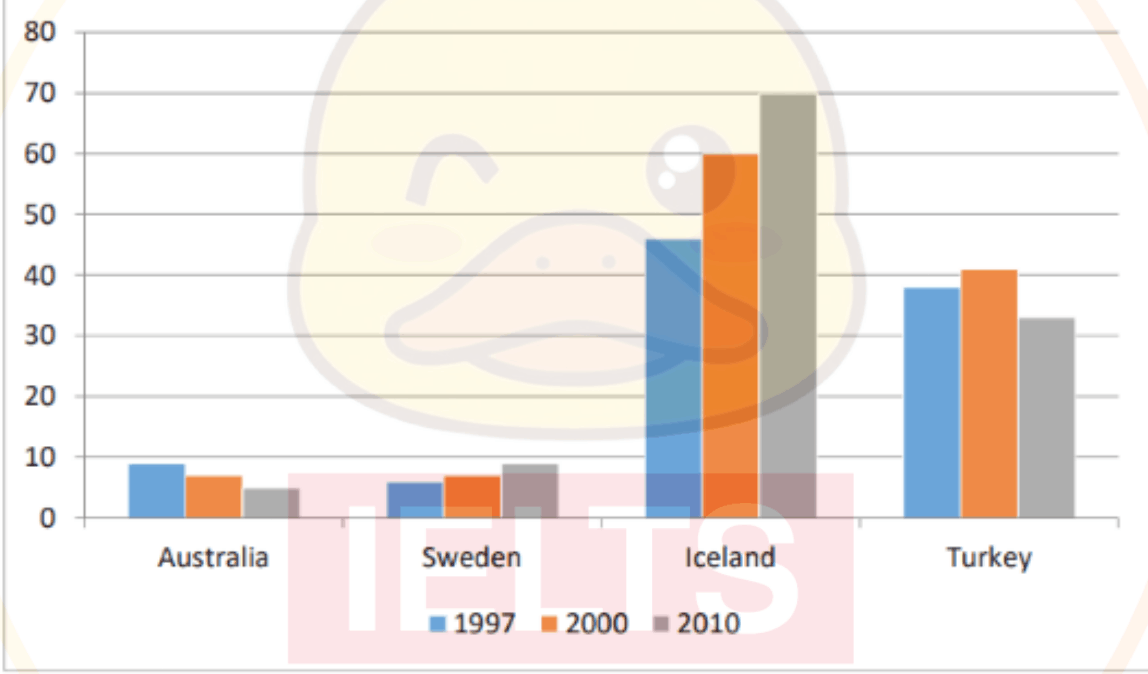
the chart shows the proportion of renewable energy in the total energy supply in 4 countries from 1997 to 2010
Practice this IELTS Writing Task 1 question on IELTSX. the chart shows the proportion of renewable energy in the total energy supply in 4 countries from 1997 to 2010
Proportion Renewable Energy Total Supply Four Countries 1997-2010 Chart - IELTS Writing Task 1
You should spend about 20 minutes on this task.
Summarise the information by selecting and reporting the main features, and make comparisons where relevant.
Write at least 150 words.
A student's answer to this task, and the feedback on it
Written by an IELTSX user under exam conditions and published unedited and anonymously. Band 6.5 · 208 words.
The bar chart illustrates changes in the percentage of renewable energy in the total supply across four distinct regions - Australia, Sweden, Iceland and Turkey - between 1997 and 2010.
Overall, it is clear that supplement of renewable energy source was by far the highest in Iceland, while Australia and Sweden supply the lowest proportion of renewable energy. In addition, Turkey's supplement was middle between Iceland's and Australia and Sweden's. Notably, the percentage of renewable energy source peaked at the end of the period in Iceland.
In 1997, about 45% of renewable energy was used in Iceland, and then the figure rose gradually to a chart-high level of 70% by 2010. Following this, the renewable energy supplement started at approximately 40% at the outset, with levelling off by 2000. The figure, however, declined slightly to nearly 30% by the final year.
There were mere difference between the proportion of renewable energy in the total energy supply in Australia and Sweden. The supplement stood at roughly 10% in Australia whereas this number was about 5% in the counterpart in 1997. Throughout the timeframe, these two countries showed contrast tendencies: energy supply in Australia decreased gradually to merely 4% while it grew in Sweden constantly to around 10% by 2010.
Examiner feedback
The response is a solid Band 6.5. It provides a clear overview and accurate data comparisons. To reach Band 7.0+, the candidate must ensure that all subjects (countries) are explicitly named in the body paragraphs and improve lexical precision, specifically by avoiding the repetitive misuse of 'supplement' and fixing minor grammatical agreement errors.
Task Achievement - 7
- The response covers all key requirements, including a clear overview and descriptions of all four countries. - Key trends are identified (e.g., Iceland's growth vs. Turkey's decline). - Data points are generally accurate, though Turkey is never explicitly named in the body paragraph, which slightly obscures the description. - The overview accurately highlights Iceland as the leader and the different standings of the other nations.
Coherence & Cohesion - 7
- Information is logically organized by grouping countries with similar or contrasting trends. - Paragraphing is appropriate and helpful for the reader. - Cohesive devices like 'Notably', 'Following this', and 'Throughout the timeframe' are used, though the transition to the description of Turkey is slightly vague because the name 'Turkey' is omitted in that sentence.
Lexical Resource - 6
- The vocabulary range is adequate, featuring terms like 'illustrates', 'distinct', and 'outset'. - There is a recurring misuse of the word 'supplement' when 'share', 'proportion', or 'contribution' was intended. 'Supplement' implies an extra addition rather than a component part. - Phrasings like 'chart-high level' and 'counterpart' are slightly awkward or misused in this context.
Grammatical Range & Accuracy - 6
- A mix of simple and complex sentences is used, but errors are present. - Examples of inaccuracies include 'There were mere difference' (subject-verb/noun agreement) and 'contrast tendencies' (should be 'contrasting tendencies'). - The phrase 'with levelling off' is grammatically incomplete/incorrectly structured.
Related prompts
- Male Female Students Art Related Subjects UK University 2011
- Town Centre Changes 1990 and Today
- Male Female Students High Grades Five Subjects Parston School National Average
- Qualifications Staff Advertising Company 1990 and 2010
- Australian School Leavers Activity 1980 1990 2000
- Layout Town Shopping Centre Present and Future Redevelopment