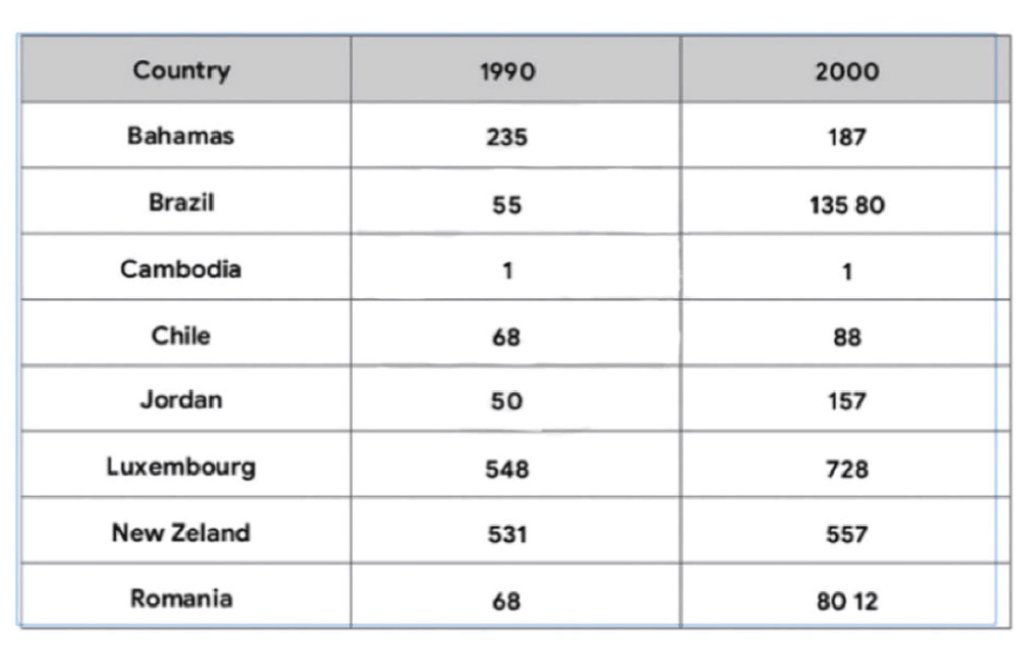
The table below shows the number of motor vehicles per 1,000 inhabitants in eight countries in 1990 and 2000.
Practice this IELTS Writing Task 1 question on IELTSX. The table below shows the number of motor vehicles per 1,000 inhabitants in eight countries in 1990 and 2000.
Motor Vehicles Per 1000 Inhabitants Eight Countries 1990 2000 Table - IELTS Writing Task 1
You should spend about 20 minutes on this task.
Summarise the information by selecting and reporting the main features, and make comparisons where relevant.
Write at least 150 words.
A student's answer to this task, and the feedback on it
Written by an IELTSX user under exam conditions and published unedited and anonymously. Band 6.5 · 249 words.
The table illustrates how the number of motor vehicles per 1,000 inhabitants changed between 1990 and 2000 in eight different countries ( Bahamas, Brazil, Cambodia, Chile, Jordan, Luxembourg, New Zealand and Romania).
Overall, it is clear that Brazil recorded by far the highest figure of motor vehicles at the end of the period, whereas the reverse was true for Cambodia, which recorded the lowest figure. While the number of vehicles increased significantly in Brazil, Jordan and Romania, that for New Zealand, Luxembourg and Chile rose moderately. Meanwhile, the number of motor vehicles in Bahamas decreased substantially, while that for Cambodia remained unchanged over the period.
Regarding the countries with notable changes, Brazil and Romania recorded the largest growth. Initially standing at 55 and 68 respectively, the figures rose dramatically to 13,580 and 8,012 over the following decade. Likewise, the number of vehicles in Jordan more then tripled, rising from 50 in 1990 to 157 at the end of the period. By contrast, the Bahamas recorded the opposite trend. In 1990, the number of vehicles stood at 235, before falling to 187 at the end of the period.
As for the remaining countries, less pronounced changes were observed. New Zealand and Chile experienced slight increase from 531 to 557 for the former country and 68 to 88 for the latter, while Luxembourg showed a slightly higher growth, from 548 to 728 throughput the period. In contrast, the number of motor vehicles in Cambodia remained unchanged at 1 throughout the timeframe.
Examiner feedback
The response provides a well-structured overview and effectively groups the countries by trends, supported by a good range of vocabulary and clear paragraphing. However, minor grammatical slips, missing articles, and major inaccuracies in data transcription prevent a higher band score.
Task Achievement - 6
- A clear and relevant overview is presented, identifying the main trends across the countries. - All eight countries are covered, and key features are appropriately selected. - Contains significant inaccuracies or misinterpretations in data transcription from the table (e.g., figures such as 13,580 per 1,000 inhabitants are unrealistic).
Coherence & Cohesion - 7
- Information and ideas are logically organised with a clear progression throughout the response. - Paragraphing is used effectively to group countries by their respective trends. - A good range of cohesive devices is employed, though transitions are sometimes formulaic.
Lexical Resource - 7
- A sufficient vocabulary range allows flexibility and precision when describing trends and changes. - Appropriate use of less common vocabulary items (e.g., 'substantially', 'pronounced changes'). - Minor spelling or word choice slips are present (e.g., 'throughput' instead of 'throughout', 'then' instead of 'than').
Grammatical Range & Accuracy - 6
- A mix of simple and complex sentence forms is employed with generally good control. - Some minor grammatical errors and missing articles occur (e.g., 'slight increase' instead of 'a slight increase'). - Complex structures show occasional inaccuracies.
Related prompts
- Male Female Students Art Related Subjects UK University 2011
- Town Centre Changes 1990 and Today
- Male Female Students High Grades Five Subjects Parston School National Average
- Qualifications Staff Advertising Company 1990 and 2010
- Australian School Leavers Activity 1980 1990 2000
- Layout Town Shopping Centre Present and Future Redevelopment