The table below shows the number of motor vehicles per 1,000 inhabitants in eight countries in 1990 and 2000.
Practice this IELTS Writing Task 1 question on IELTSX. The table below shows the number of motor vehicles per 1,000 inhabitants in eight countries in 1990 and 2000.
Motor Vehicles Per 1000 Inhabitants Eight Countries 1990 2000 Table - IELTS Writing Task 1
You should spend about 20 minutes on this task.
Summarise the information by selecting and reporting the main features, and make comparisons where relevant.
Write at least 150 words.
A student's answer to this task, and the feedback on it
Written by an IELTSX user under exam conditions and published unedited and anonymously. Band 7 · 218 words.
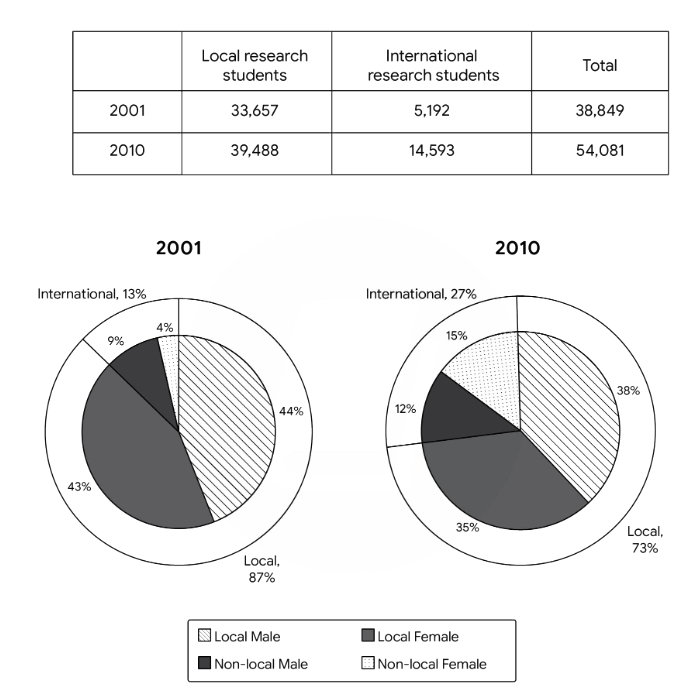
The table and pie charts illustrate the number and composition of research students in a particular country in 2001 and 2010, distinguishing between local and international students as well as gender.
Overall, the total number of research students increased significantly over the period, largely driven by a sharp rise in international enrolments. While local students still formed the majority, their proportion declined, and the gender distribution became more balanced among international students.
In 2001, there were 38,849 research students in total, including 33,657 locals and 5,192 internationals. By 2010, the overall figure had risen markedly to 54,081. This growth was mainly due to international students, whose numbers almost tripled to 14,593, whereas the number of local students saw a more modest increase to 39,488.
Regarding proportions, local students accounted for 87% of all research students in 2001, but this share fell to 73% in 2010. Conversely, the proportion of international students more than doubled from 13% to 27%.
In terms of gender distribution, in 2001, local students were almost evenly split, with males slightly higher at 44% compared to 43% females. Among international students, males (9%) outnumbered females (4%). By 2010, however, the gender gap among international students narrowed, with females rising to 15% and males to 12%. Meanwhile, among local students, females (38%) slightly outnumbered males (35%).
Examiner feedback
While your writing proficiency is clearly at a Band 9 level in terms of grammar, vocabulary, and organization, your score is severely limited because the response is completely off-topic. You have written a perfect description for a task about research students, but the prompt provided was about motor vehicle ownership in eight countries. In a real exam, this would result in a Band 1 for Task Achievement.
Task Achievement - 1
- The response is completely unrelated to the provided task. The prompt asks for a description of motor vehicle ownership in eight countries, but the response describes research students and gender distribution. - Because the content does not address the prompt's subject matter (motor vehicles), it cannot be awarded marks for task fulfillment, regardless of the quality of the writing. - There is no mention of the eight countries or the specific data points regarding vehicles per 1,000 inhabitants.
Coherence & Cohesion - 9
- The message can be followed effortlessly; information is logically sequenced with a clear progression from an overview to specific details. - Cohesion is used seamlessly, with sophisticated referencing (e.g., 'this growth', 'this share', 'meanwhile') that never attracts undue attention. - Paragraphing is skillfully managed, with each paragraph focusing on a distinct aspect of the (albeit incorrect) data.
Lexical Resource - 9
- The response demonstrates full flexibility and precise use of a wide range of vocabulary (e.g., 'composition', 'distinguishing between', 'markedly', 'narrowed'). - Collocations are natural and sophisticated (e.g., 'modest increase', 'gender distribution', 'largely driven by'). - There are no spelling or word formation errors; the language used is of a native-like standard.
Grammatical Range & Accuracy - 9
- A wide range of structures is used with full flexibility and accuracy (e.g., 'While local students still formed...', '...narrowed, with females rising to...'). - Punctuation is used appropriately throughout to enhance clarity. - Every sentence is error-free, demonstrating a masterly control of English grammar.
Related prompts
- Male Female Students Art Related Subjects UK University 2011
- Town Centre Changes 1990 and Today
- Male Female Students High Grades Five Subjects Parston School National Average
- Qualifications Staff Advertising Company 1990 and 2010
- Australian School Leavers Activity 1980 1990 2000
- Layout Town Shopping Centre Present and Future Redevelopment